
October Guest College Football Column
By Vinny Jace, Special to the15net dot com:
Tar Heel fans might need to self-medicate after these last two games. Sure, they’re huge wins that invoke dreams of making it to a bowl game, but these contests are not for the faint of heart. Football is a game of inches, its margin of error nearly invisible. One or two plays can wildly alter the perception of figures whom you’d initially think should be above being slaves to the variance that is collegiate football.
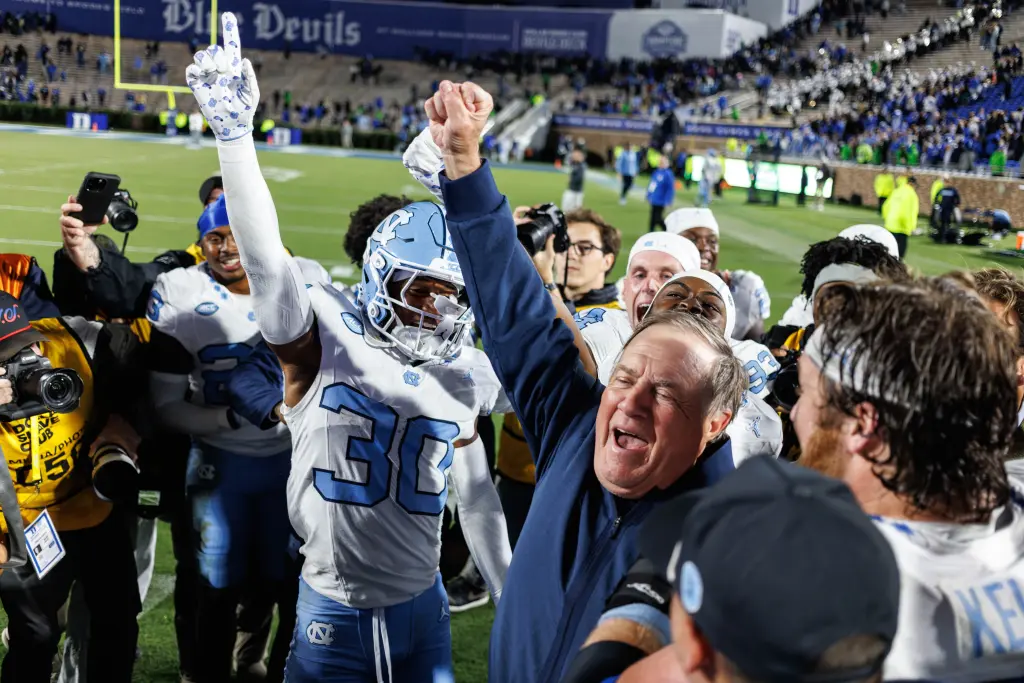
If a hard-fought loss would have been enough cause to demand heads—or a head, to be precise—to roll at UNC, I won’t return fire and say Duke should fire Manny Diaz. They shot themselves in the foot, dug themselves out of a hole, and nearly kept the Victory Bell in their possession. It just didn’t happen this time. A late-game drive by UNC powered them over their in-state rival for a 24-20 win that doubles as a modest upset.
Instead, I want to highlight the execution of the Tar Heels and celebrate their accomplishments thus far, six games into the season. Entering the 2026 campaign, the mood was dour. Traditional media outlets saw the gauntlet of a schedule the Tar Heels were saddled with and thought it charitable to throw them four wins. Fans of the university became enamored with apathy, wishing for UNC to foreclose on its football program and focus on basketball.
Watching Tar Heel fans succumb to defeatism eerily reminded me of Patriots fans who’d watch their team go 12-4 every year but seemed to look for permission from the outside world to enjoy what they were seeing.
To rectify what went wrong in 2025, Belichick reshuffled the deck on the coaching staff. Hiring Bobby Petrino caught many people off guard, including me. But in hindsight, it was a sign Belichick was still able to get a big fish into his pond and adapt his professional background to fit the college style.
Previous offensive coordinator Freddie Kitchens wished to run a rigid, pro-style offense. Being a pro coach, Belichick was probably open to keeping someone who spoke his language as he embarked on this new, unfamiliar terrain.
The 2025 Tar Heels offense was slow and predictable, finding itself often behind the chains. If your first-down play results in a loss of 5 yards, leaving you staring at a 2nd and 15, you can essentially get the punt team ready. Opposing defenses knew UNC could only excel in short-yardage situations, so they’d stack the box, force Gio Lopez to throw, and defang the one thing UNC could do well with ease.
In my view, we don’t appreciate the fact that while college is a step below the professional ranks, it does pose a unique series of challenges for coaches. Coaches who are used to working with veterans nearing the age of thirty are suddenly working with raw talent just entering their twenties. Kitchens’ pro-style offense amounted to a mere 288 yards per game, ranking an abysmal 128th in the nation.
Belichick’s mistake was not being flexible. He did not allow Lopez to audible at the line, wishing to control the game entirely from the sidelines. Lopez is a raw, younger player who needed to learn a complex, NFL-style scheme that he likely was not ready for. In Belichick’s eyes, Lopez didn’t possess the ability or the experience needed to diagnose complex defensive disguises. Lopez, currently the starting quarterback for No. 21 Wake Forest, is having a breakout year, throwing 17 touchdowns to just one interception. That fact alone shows not even Belichick is above needing time to adapt. It stems from the faulty assumption that if professional athletes can handle a 500-play volume with micro-managed pre-snap restrictions, college kids should find it even easier because the talent is a step down. But the difference between NFL and college players is that the former are full-time employees. The NCAA restricts activity to 20 hours a week. As laughable as it seems, the rules still prioritize college athletes as “student-athletes” who need to get to class.
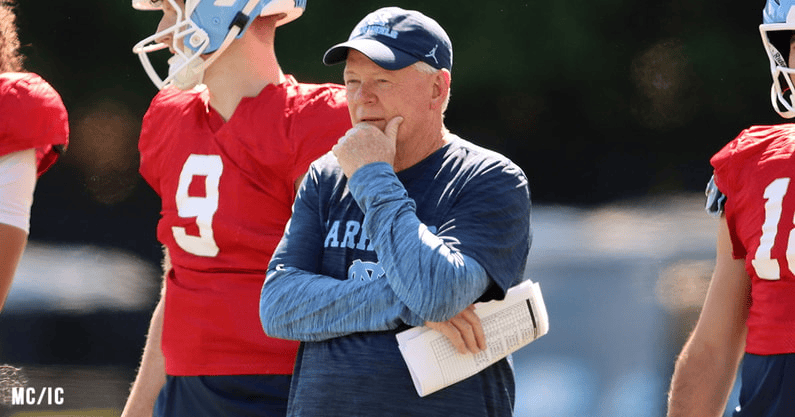
The Tar Heels needed more flexibility and imagination. Petrino came in and instituted a college-proven system that features elements of the “veer and shoot” alongside heavy personnel packages. He brought a massive infrastructure, utilizing pre-snap looks and creativity to manufacture plays that simply did not exist under Kitchens. Petrino found ways to utilize having two or even three tight ends on the field at once to create heavy blocking advantages, successfully unlocking the multi-back committee of Demon June, Benjamin Hall, and Jaylen McGill.
While Lopez was straightjacketed by Belichick & Kitchens, Petrino has trusted Billy Edwards Jr. with the structural freedom to make adjustments at the line based on defensive alignment. The raw per-game stats suggest a clear upward trend. The paltry 183 passing yards in 2025 is now a workable 218. The infinitesimal 6.2 yards per attempt last season rose to 7.9.
What we’re seeing is a merging of Erhardt-Perkins with college concepts. A non-negotiable rule for Petrino is putting pass protection above everything else. He is not afraid to slow down the tempo and streamline the pass protection terminology.
When we talk about Belichick adapting to the college game, Petrino having to change his language to better fit this hybrid-style offense also deserves attention. NFL playbooks use rigid, wordy play-calls where every single specific route, protection adjustment, and alignment is explicitly spelled out in a long string of text. Petrino finding a way to merge traditional elements of Erhardt-Perkins with modern college shorthand—using single-word concept tags like “snag”, “tosser”, or “mesh” and having everyone on the field know their individual responsibility by just those terms—is nothing short of miraculous.
Under Petrino and newly promoted running backs coach Natrone Means, the Tar Heels’ ground game developed into a three-pronged attack able to carry the burden. Hall is the early-down specialist; June is the physical, short-yardage and red-zone back; and McGill plays the hyper-efficient change-of-pace role (exemplified by his clutch 24-yard game-winning run against Duke).
There is still a lot of work to be done, as the flaws are noticeable. The offense can burn bright for one quarter, then go AWOL in the ensuing quarters. But what’s established is a know-how, a willingness to get down and dirty, and poise in the face of overwhelming adversity.
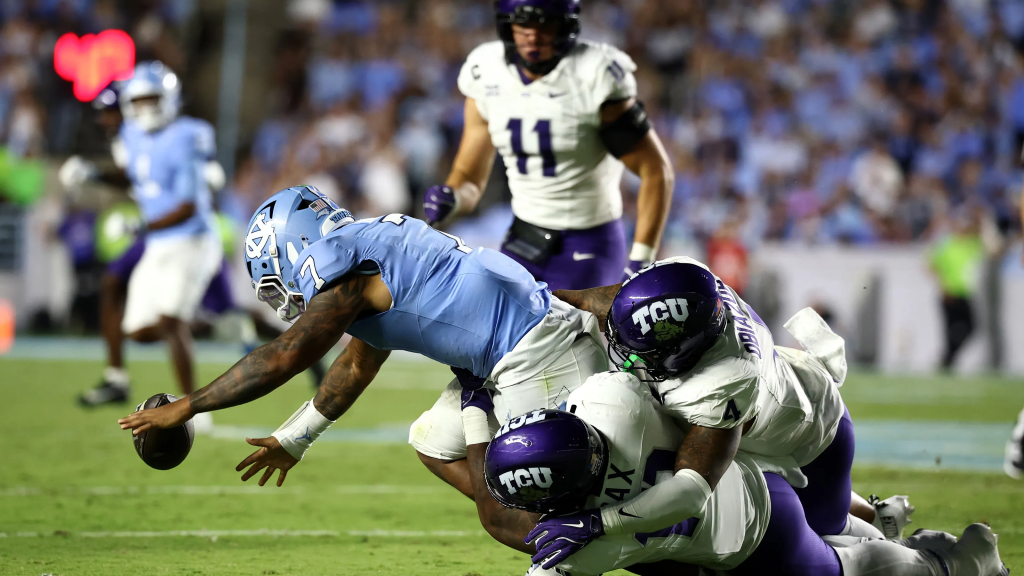
The recent contest against Duke exemplified the anomalous tendencies of the Tar Heels. They jumped out to a 17-0 lead, taking advantage of sloppy football from the opponent. Then, instead of shutting the door, they left it open for Duke to walk through. Jordan Shipp fumbled, which led to a Duke defensive score. McGill fumbled in their own end zone. And then a muffed punt gave Duke another short-yardage score.
Suddenly, they were facing a fourth-and-four at their own 28, down by three points. The game, and arguably the season’s momentum, was on Edwards’ shoulders. The offense had stagnated since leaping to that 17-0 lead. Edwards stood firm in the pocket and zipped a pass over the middle to tight end Jelani Thurman, who made a clutch 12-yard catch to move the chains and keep the game alive. A few plays later, UNC took the lead and, eventually, secured the win.
That’s confidence. That’s big-boy football. And that’s exactly what we hope to see from the Tar Heels in the second half of this season.
Vinny Jace is a special contributor to The15net.com.

